
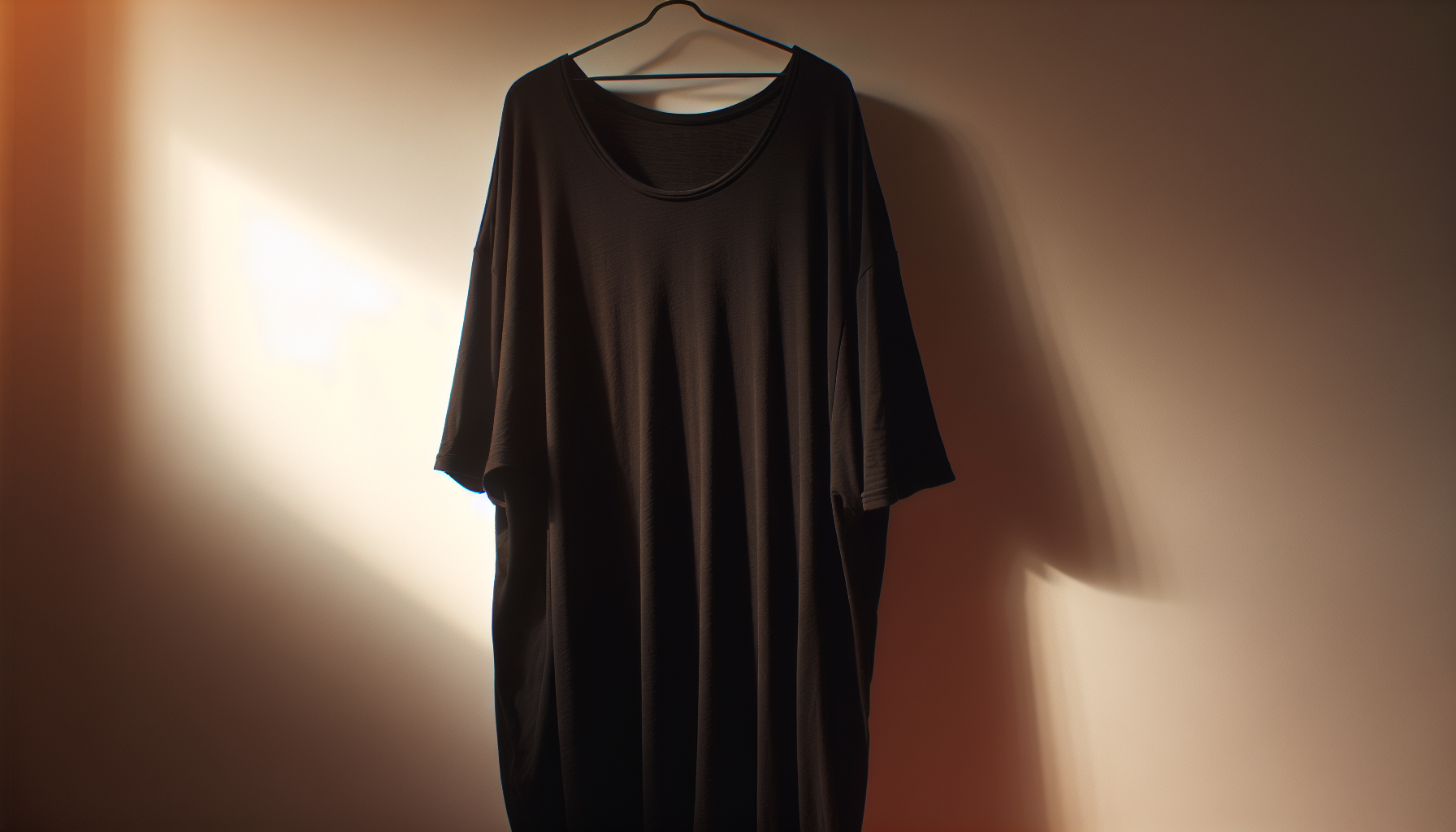
The first clothes that let my body exhale did not look like freedom. They were not some Instagram outfit, not a styled photoshoot, not the thing you lay on the bed to take a picture of before you put it on. They were soft in a regular way. They were plain in a familiar way. If you saw them on a hanger, you might walk right past, go hunting for something “cute.” But my body still remembers the first time the fabric touched my skin, how my shoulders dropped like they had been waiting for that moment since birth.
I grew up in a house where clothes were instructions. You put on what you were told. You wore what was cheap, what was on sale, what could be “grown into.” My body was always a size ahead of whatever my mama hoped. She would stand in the store, squint at me, hold a shirt up like a question and say, “Turn around. Pull your arms up. Sit down in it.” There was a way she watched the seams, like they were warning signs on the highway. If the fabric pulled, if my stomach said hello through the cotton, that meant I had failed some test we never agreed to take.
There is a particular kind of silence that happens in a dressing room when you can’t zip the jeans. It is not quiet. You hear your breathing get louder. You hear the fluorescent light buzzing over your head. You hear the little grunt you make trying to pull denim over hips that refuse to be negotiated with. Then your brain starts shouting. All the old words. Too big. Too much. Why you eat like that. This why you single. The jeans stay folded. The words do not.
For years, my clothes were strategies. Dark colors to disappear the curve of my belly. Button-ups to apologize for my chest. Belts pulled so tight my ribs learned to hold their breath. I wore cardigans like armor in June and July, sweating through the fabric, pretending I was just “cold natured.” If a shirt clung to me in the wrong way, I punished my body for it. I would grab the flesh at my sides and pinch like I could scold it smaller. Every mirror was a court date. Every outfit was evidence.
I remember this one church Easter Sunday, the year my aunt decided I was “too grown” for the kids section. She brought me this stiff lavender dress, all shiny polyester and lace that felt like it was judging me. When I put it on, the lining scratched my arms. The zipper did that thing where it goes up but not smooth, catching over the small of my back like the dress itself did not want me. Everyone said I looked “nice.” I spent the whole service in the pew, holding my breath so my stomach wouldn’t press against the front. Jesus rose, but my diaphragm did not.
So the bar was low when the first exhale clothes came. I was in my early twenties by then, freshly queer in public, broke in a way that tastes like ramen seasoning on everything. One afternoon I wandered into this discount store, the kind with bins of unbothered cotton and a soundtrack of someone’s uncle coughing in the next aisle. I was not looking for anything specific. I just needed something that did not remind me of an office job or a family gathering.
That’s when I saw it. A black t shirt dress, hanging off a plastic hanger with the hook turned the wrong way. It had no shape on purpose. Short sleeves. Soft cotton. A simple crew neck. It was a size too big, maybe two, and the tag said something like “relaxed fit,” which sounded like a whole prayer by itself. I touched it and my fingers sank in a little. It felt like an old favorite I hadn’t met yet.
In the same bin, there was a pair of gray sweat shorts. High waist. Thick waistband with a drawstring. The kind of gray that makes every curve look like a soft shadow. I picked them up and laughed because they looked like something a butch auntie would wear to the cookout. Comfortable, slightly inappropriate, guaranteed to get phone numbers near the potato salad. The fabric was plush inside, like it had opinions about my comfort.
I bought both for what felt like $7 and an apology to my overdrafted account. At home, I kicked off the jeans I had been fighting all day and pulled the shorts up first. There was no struggle. No dance. No laying on the bed to get the zipper to agree. The waistband met my stomach like it had been expecting that exact curve. My belly rolled over the top a little and for once it did not feel like a mistake. It felt like a shelf for my joy to sit on.
When I slipped the t shirt dress over my head, I braced myself out of habit. I was ready for the catch at the shoulders, the places where fabric usually argues with my upper arms. But it just glided down. It fell over my chest, my waist, my hips, all the parts I had been trying to negotiate out of existence. The hem brushed right above my knees. I looked down and could see my thighs, brown and dimpled, comfortable inside their own thickness.
In the mirror, I did not look “snatched.” There was no illusion of flatness. My belly was there. My chest was there. The curve of my back, the way my butt sat like a question mark at the bottom of my spine, all of it present. What was new was the quiet. No pinching. No seams pleading for mercy. No waistband making a ring around my middle like a bruise. My body did not feel like it was performing. It felt like it had sat down on the couch and taken its shoes off.
Something happened in that mirror. It was small, and I almost missed it. My shoulders dropped in this slow way, like they were not falling but remembering. My jaw unclenched. I did not pull at the hem to stretch it lower. I did not turn sideways and try to suck my stomach in. I just stood there and watched my chest rise and fall under all that soft black cotton. For the first time in years, the breath going in and out of my body was not a negotiation. It was just breath.
I had spent so long thinking comfort was a treat you earn once you look “better.” One of those things you buy later, after the weight loss, after the revenge body, after the imaginary glow up that was always six months away. Standing there in my discount-store holiness, I realized my body was not a project waiting on approval. It was a home that had been living under renovation signs for years. And these clothes, plain as they were, had just walked in and said, “We good right now.”
I wore that outfit everywhere for a while. To the corner store. To late-night drives with friends, music up, windows cracked just enough to let the city in. To queer kickbacks where smoking on the stoop felt like communion. There are pictures of me from that time, laughing with my whole mouth, belly soft and joyful under black cotton. In every one, you can see that my body is not on guard. You can see that I am inside myself, not just standing next to myself trying to pose.
Of course, the world did not suddenly become kind because I found a t shirt dress and some shorts. People still stared. Family still made comments. Aunties still asked if I “really needed seconds” at the cookout. There were days I put on that same outfit and still heard the old voices talk slick in my ear. But now I had this memory in my body of what it felt like to breathe all the way down, to let fabric touch me without apology. That memory started arguing back.
I began to ask different questions when I shopped. Not “Does this make me look smaller?” but “Can I actually sit down in this and still like myself?” Not “Will they think I’m doing too much?” but “Can I dance in this and feel my thighs clap like they paying me a compliment?” I started reaching for softness first. Stretch first. Room first. I let colors that loved my skin climb into my closet. I let crop tops inch their way up my torso, stopping right where my belly begins, that sacred horizon line.
What I am learning, over and over, is that my fat Black queer body deserves clothes that do not treat it like an inconvenience. My softness does not have to be argued into every outfit. Comfort is not a costume I put on in private then hide when it is time to be seen. It is a language, and my body has always been fluent, even when my mind was stuttering.
The first clothes that let my body exhale were not special to anybody but me. Somebody else probably bought the same dress, wore it once and forgot it in a drawer. Those gray shorts might be sitting on another person’s floor right now, crumpled next to a laundry basket. But in my life, they marked a doorway. A before and an after. Before, when my clothes were tiny cages. After, when fabric became a soft invitation to stay.
If you are reading this and your jeans are digging into your stomach while you scroll, I am not going to tell you to love your body on command. That is too much pressure for a Tuesday afternoon. I will say this though. There is a version of you that has already exhaled somewhere. Maybe in an old college hoodie. Maybe in a thrift store dress that fell just right. Maybe in the oversized t shirt you keep stealing from somebody’s closet. You are not imagining that relief. Your body remembers.
And maybe, when you can, you let that memory drive next time. You pick the pants that let your belly exist in peace. You choose the shirt that doesn’t ask your shoulders to audition for a role. You walk past the thing that hurts even if it looks “sharp.” The world will still be the world, loud and opinionated and wrong about you most days. But under all that noise, you might feel your own breath moving in and out, steady and unbothered, wrapped in cotton that finally understands.
That is the gift those first clothes gave me. Not a new body. Not a makeover. Just permission to live in the one I have without holding my breath. And on the days I forget, I go back to something soft, pull it over my head, and wait for that familiar settling. My shoulders drop. My chest rises. My belly says “hey” to the waistband. And together, piece by piece, we exhale again.