
The Tapestry of Dwellings Woven by Connection
Some nights, I carry my body through the door like it’s a borrowed jacket—tugging at the sleeves, adjusting to fit, never forgetting the weight of too many eyes stationed in the lintels, watching. I didn’t used to walk so upright, didn’t used to let my light do anything but flicker at ankle height, praying nobody saw me shining to my own rhythm. The South has a way of teaching you to hush yourself, tuck the loudness of your heart into smaller, quieter places. For years I was just a whisper in rooms I ached to fill, shrinking so I wouldn’t spill.
But the quiet was never home, just an attic I got locked in. I learned eventually that belonging isn’t about fitting in; it’s about letting yourself spill into the space you deserve.
I come from red dirt and the green edge of pines, my mama’s hands always busy—snapping beans, curling my baby hair, sometimes folding into silent prayers over a bowl. My daddy, when he was around, was all thunder and sweat and gospel. Sunday mornings: starch in the collar, the black grit of our shoes, the sweet hunger for cornbread and the unspoken hope behind every hymn. The church offered home as long as I kept my softness zipped and my truth double-bolted—but I was always too tender, too neon, too unwilling to let the music and glitter die in my throat.
It took years to unlearn the tuck-in-your-shirt Sunday school version of me. Queerness came at me not like a hurricane, but like slow, crawling sunrise: a knowing before a speaking, the ache of seeing myself in borrowed pronouns and secret crushes. The first boy who let me hold his hand behind the gym was trembling too, and I remember our palms slick and dumb and holy. If anyone had seen us, we would’ve vanished in a hiss of shame. Instead, we made a hiding place between our bodies—a truth that, for a moment, belonged only to us.
Back then, home was a jittery thing. Sometimes it was my own room, the soundtrack of midnight crickets, tears soaked into my pillow after another too-quick prayer at dinner (“Lord, bless this food and make us good”). Sometimes it was the flicker of a stolen lipstick, the wildness of my laughter with cousins in the back room, braiding each other’s hair, spinning until we fell. Sometimes it was nowhere at all.
I can’t pin a single root to my queerness, but I do know that what finally bloomed was impossibly soft and durable, like moss on a stone: stubborn, green, a little bit magic. I started searching for home among the unquiet ones—the ones whose arms flew when they danced, whose mouths knew where to find softness in each other, who risked declaring the right to be more than survival, to take up the space joy demands.
Queer community arrived for me one halting Friday behind an old pool hall in Birmingham, smoky and ragged and sacred. It wasn’t rainbow flags or parades. It was a borrowed couch, pounding heartbeats in the ceiling, the hush after the music died when someone touched my shoulder and said, “Darlin’, you look like you need company.” I did, and I wasn’t shy about it. I needed to be seen, needed a place to set down the ferocity of loneliness I’d been hauling since boyhood. That night, I let myself laugh so hard my jaw ached. A queen named Miss Loretta wrapped herself around me and ordered chicken wings for us both—lemon pepper, just a touch of heat. They taught me how to lose a game of Spades with grace, how to flirt with the knowing that I was wanted, here, my full and extravagant self, sequined sadness and all.
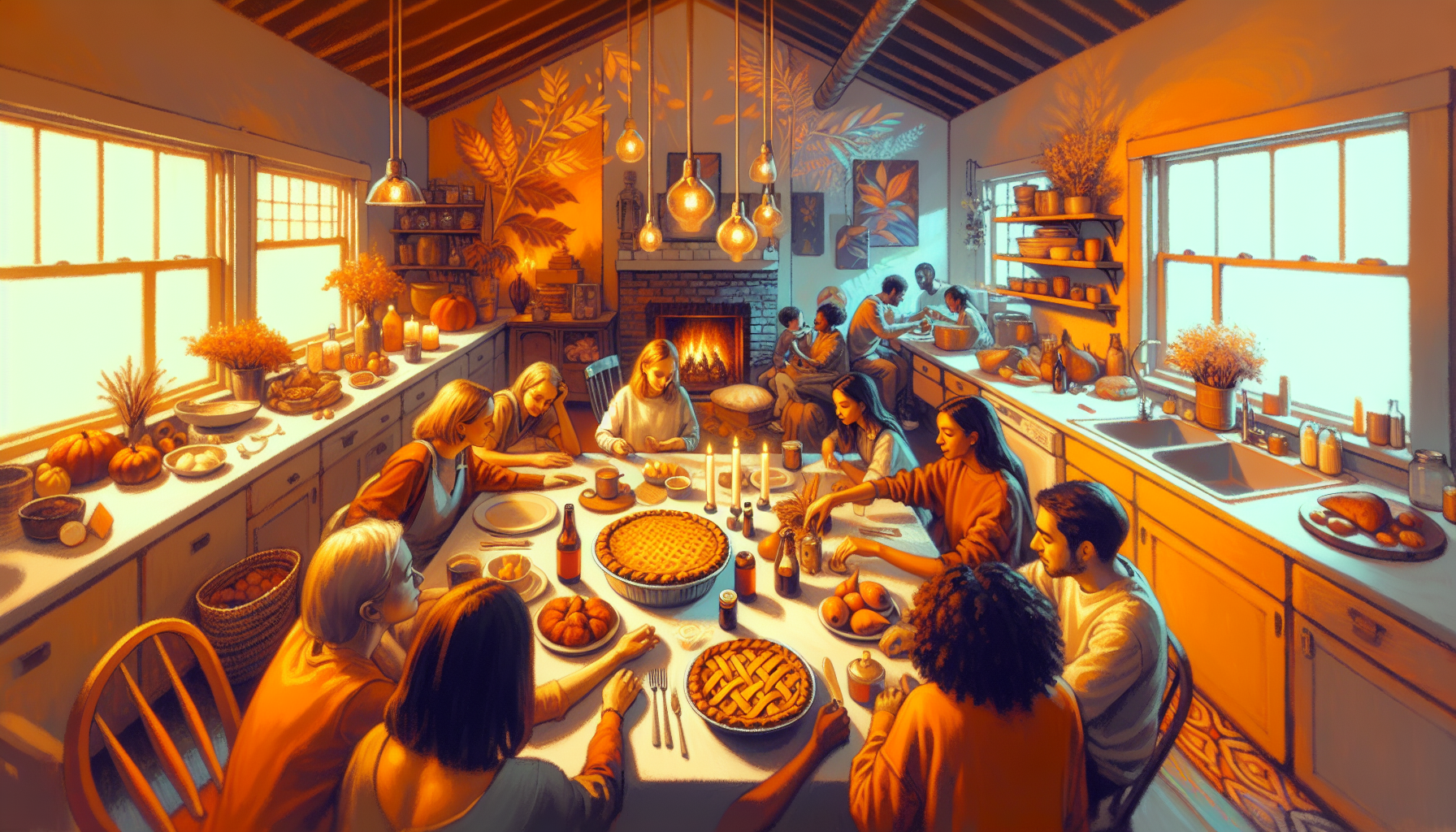
Years later, my friendships look like a kitchen during the holidays: seasoning in every air pocket, a riot of laughter, the gauzy hum of belonging you can almost taste. My chosen family is a constellation—scattered, shining, gravitational. Solange on the speakers, candles burning down to puddles. Sometimes Mama’s sweet potato pie recipe gets passed around, the crust falling apart but the filling warm and cinnamon-loud. We hold each other up when the world is ragged with teeth. My home exists in their text threads, in the late-night call when someone’s heart broke open under the weight of the world, and we all stayed on the line as long as it took.
There’s grief here, too—not just the loss of kin who chose their rules over my soul, but the ghosts of smaller selves who tried to fold up joy so it wouldn’t take up space at the table. Sometimes I hear the old voices, the Sunday morning silence where love should’ve echoed. And sometimes, I cry for that boy—partly out of mourning, partly out of thanks, because he kept burning, even when the windows were all painted shut.
Southern air is thick, humid, tender—like a hand pressed to your back, guiding you somewhere strange and necessary. My body has learned to love itself out loud: brown skin glistening in June heat, rolling my hips to the pulse of old-school R&B, singing every word meant for mouths like mine. The shape of my love is angular some days, velvet and riotous on others, rooted in the cracked sidewalk of my grandmother’s porch and the wild, weedy gardens my friends and I have built for ourselves, inch by inch, day by day.
These days, I believe in dwellings not bounded by brick or blood. Home is a verb, an unfolding, a sweat-slick promise in the embrace of my chosen kin. It is confession, reclamation—a patchwork quilt, inherited and stitched new, every story a square edged in forgiveness and wild hope. When I look around and see us—black and queer and complicated and holy—I see every scar, every hymn, every unspooling memory woven together. I see the shimmer of survival, but also the hallelujah of arrival.
Sometimes, people ask me how it feels to belong. I tell them: It feels like laughter thick as honey in a crowded kitchen, like a drag queen’s rhinestone kiss on my forehead, like hearing my own unruly voice ripple through a room that’s glad I’m there. It feels like standing on my own bare feet, unshrinking, every inch of me welcome in the woven softness of community. I gather all the versions of myself—boy and man, quiet and loud, afraid and electric—and let them nestle into each other. There’s room for all of us here. We are the living tapestry, and we make this place home by gathering, again and again, in the thrilling, trembling certainty that we are enough.