Press & Media
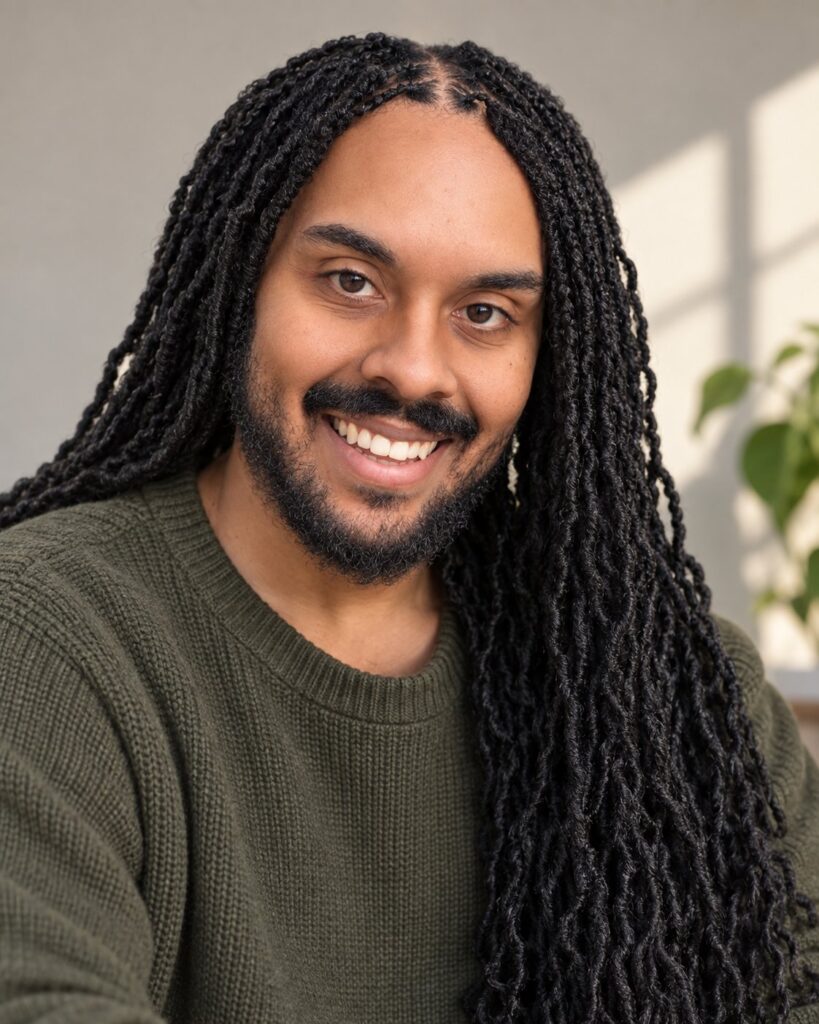
Kabal Briar (pronounced “Cable”) is a Black, queer, award-winning poet, author, educator, and speaker based in Bellevue, Washington. For interviews, features, readings, and speaking requests, start here.
Why I Wrote It, Who It’s For, and What I Hope It Leaves Behind
I’ve spent an extraordinary amount of my life somewhere else while technically being right here.
As a child, I could build entire worlds in my head. I could imagine different homes, different futures, different versions of myself. As I got older, those daydreams became more elaborate. I rehearsed conversations that hadn’t happened, revisited ones I wished had gone differently, and imagined a life where I was a little more confident, a little more successful, a little more comfortable in my own skin. And, naturally, better dressed.
But somewhere along the way, I started asking myself a question: What happens when the life you’re imagining becomes more familiar than the life you’re actually living?
That’s where Somewhere Better in My Head began.
I wrote this book because I wanted to explore our relationship with imagination beyond the usual conversation about escaping reality. We talk about daydreaming as though it’s a distraction, something we should grow out of or learn to control. But I think our imaginary worlds deserve a little more credit than that.
Sometimes imagination is shelter. Sometimes it’s entertainment. Sometimes it’s how we survive an afternoon we cannot wait to be finished with. And sometimes, whether we realize it or not, it’s the first place we allow ourselves to want something we haven’t yet found the courage to pursue.
Of course, imagination has another side. It’s possible to become so attached to a future version of your life that you forget to participate in the one you already have. You keep waiting for the better apartment, the better body, the better career, the better circumstances. You convince yourself that happiness belongs to somebody you’re still becoming.
I know that feeling. I’ve lived in that waiting room.
This book is for the overthinkers, the dreamers, the outsiders, the quiet observers, and the people who have ever disappeared into their own minds without physically going anywhere. It’s for anyone who has imagined a different version of themselves just to see how it might feel. It’s for the people who replay conversations in the shower, invent entire futures on their commute, or secretly believe there’s another life somewhere with their name on the mailbox.
And it’s also for the people who aren’t sure whether their imagination is helping them move forward or keeping them comfortably stuck.
Through essays, poetry, collage, humor, and interactive reflections, I invite readers into that complicated space between the lives we imagine and the lives we inhabit. The book is personal, sometimes ridiculous, sometimes uncomfortable, and intentionally playful. I wanted readers to recognize themselves, laugh at themselves a little, and maybe discover something unexpected about the places their minds keep returning to.
At the center of it all is a philosophy I’ve come to believe deeply:
Imagination isn’t just an escape from reality. It’s one of the ways we learn what we want from it.
Our daydreams can reveal the things we’re missing, the desires we struggle to articulate, and the versions of ourselves we’ve never quite given permission to exist. But not every fantasy needs to become a goal. Not every imagined future is a life we’re supposed to pursue. Sometimes a daydream is simply a beautiful place to visit. Sometimes it’s a warning. Sometimes it’s trying to tell us something about the Tuesday we’re currently avoiding.
The important thing is learning to recognize the difference.
I don’t want anyone to finish Somewhere Better in My Head believing they need to stop daydreaming, become endlessly productive, or turn every beautiful thought into a five-year plan. Good Lord, that’s exhausting.
I want them to become curious about their own imagination. To ask themselves why certain fantasies keep returning. To recognize when their inner worlds are giving them comfort and when those worlds are quietly asking them to change something.
Most importantly, I want people to understand that you don’t have to become the person you’ve imagined before you’re allowed to enjoy being the person you are.
You can still have unfinished dreams, unanswered questions, ambitious fantasies, and a life that’s worth showing up for today.
Maybe the apartment isn’t perfect. Maybe the career hasn’t happened. Maybe you still think of the perfect comeback two days too late. There’s still something here worth experiencing.
Somewhere Better in My Head isn’t about giving up the worlds we create inside ourselves.
It’s about realizing that we can visit those worlds, learn something from them, and bring a little of that possibility back with us.
Because maybe the somewhere better we’ve been searching for isn’t an entirely different life.
Maybe it’s something we can begin making room for in this one.
And maybe, for today, that’s enough.
Featured review
MOUTHY, reviewed by Literary Titan. Five stars, June 2026.
“Mouthy is a fiercely intimate poetry collection about reclaiming a voice after years of being taught to shrink.”
— Literary Titan
“What moved me most is that Mouthy doesn’t mistake volume for healing.”
— Literary Titan
Interview
“Learning to Trust My Voice.” Literary Titan, June 2026. Kabal on building MOUTHY, softness as strength, and learning to trust his voice.
Literary publication
“I Was Tender Before I Was Trouble.” American Poetry Journal, October 2026.
A second poem, “Things I Thought God Was Mad About,” appears in the same issue. See the issue
Awards and recognition
- Winner, International Impact Book Award (MOUTHY)
- Gold winner, Literary Titan Gold Book Award for Poetry, 2026 (MOUTHY)
- Pushcart Prize nominee, 2026 (“The River Was Not Water,” nominated by Fifth Wheel Press)
- Highly Commended, Washington Poets Association 2026 Poetry d’Amour (“The Last Good Peach at the Bottom of the Bag”). See the winners
- Work appears in the American Poetry Journal, October 2026
Anthology
Contributor, Way Downstream (Fifth Wheel Press, 2026).
Announcements
“Kabal Releases MOUTHY: A Spoken-Word EP Streaming Now With Book to Follow” (January 2026, distributed announcement). Read the announcement
Books
- MOUTHY: Poems in Defense of Being Loud, Soft, Queer & Undeniable (Woodbridge Publishers, February 2026), ISBN 9781807044381. About the book
- Somewhere Better in My Head (out now). About the book
Short bio
Kabal Briar (pronounced “Cable”) is a Black, queer, award-winning poet, author, educator, and speaker based in Bellevue, Washington. His debut poetry collection, MOUTHY: Poems in Defense of Being Loud, Soft, Queer and Undeniable (Woodbridge Publishers, 2026), won the International Impact Book Award and the Literary Titan Gold Book Award for Poetry. His work appears in the American Poetry Journal (October 2026), and he is a 2026 Pushcart Prize nominee. He has performed on the Bellevue College PrideFest mainstage and as the City of Bellevue Pride keynote speaker.
Press contact
fashionablykabal@gmail.com
kabaltv.com | Instagram: @fashionablykabal