
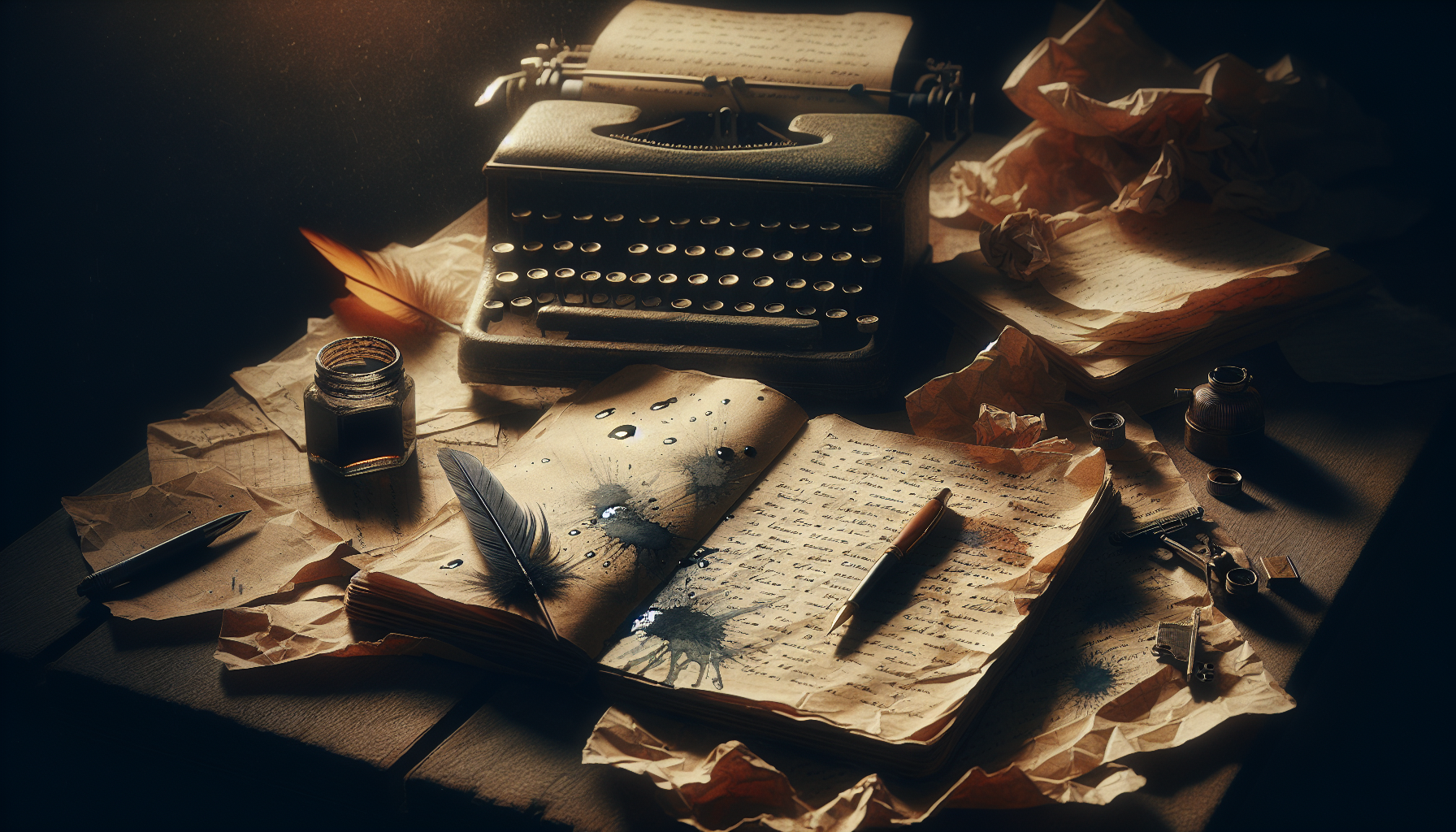
Some Poems Begin as Whispered Secrets I Dare Not Speak Aloud
Truth is, some of my sentences come out sideways, slip from my jaw heavy as sweat, thick as borrowed sorrow. I don’t always know what to do with that—feeling a poem starting somewhere in the tender dark behind my ribs, coughing up the first word like I’m testing to see if my voice will crack. Sometimes it does, spectacularly. Sometimes all I have is a phrase trembling inside my mouth like a hummingbird in a hand, and I press my lips shut, afraid the world isn’t listening gently enough.
When I sit at my desk, surrounded by the kind of sticky Southern heat that makes skin earnest and every muscle in my back think of home, I whisper to myself. The fan tries its best, but mostly it’s just me and the hush, wrestling with lines that remind me of who I almost wasn’t. Years curled inward like the paper of a burnt-out Bible—pages that held someone else’s red-ink notes and my own thumbprints, hidden in the margins.
I learned early how to fold myself: quiet, polite, unruffled. “Black men don’t cry. Don’t you raise your voice.” The classrooms were always chilled—air conditioning that bit my brown arms, but I kept my hands folded, my questions silent. I bit back all the “what ifs” and “what abouts” and “may I be truly seen?” I understood: surviving meant shrinking, invisibility as shield. But now, every draft is a kind of undoing—a slow, stubborn reclamation. I let my poems leave crumbs, soft and deliberate, to lead me back to the places I’ve hidden.
There are days the work feels like coaxing a wounded animal. The words scatter, skittish, half-feral. And I confess, I love the mess of it. The notebooks full of unfinished things, loops of ink where I pretended I didn’t care, crossings-out with too much force, torn paper. Some lines I keep writing over and over—“I have a body”—because even now it’s magic, dangerous, holy to say it. I try to fit desire in the shape of my tongue. Not just wanting, but wanting aloud, wanting with color, with all my scars showing.
Sometimes I revise until the poem doesn’t look at all like what started it. My drafts are graveyards of old selves, stanzas that loved me wrong, metaphors too sharp for my own hands. I cut them, but never quite throw them out. I let my poems contradict themselves, fall apart, stitch themselves back mule-mean, stutter-step, gorgeous in their unevenness.
When the poem gets stuck, I get up and listen to my mother’s voice as if it’s rising from the hot iron skillet or the syrupy hymn inside the walls. Sometimes I walk. My thighs rub, arms swinging, sweat gathering in the hollow of my neck, and there’s a heaviness, but it’s not shame anymore. The body doesn’t apologize. Sometimes it sings—a broken, leftover gospel for whoever I was before I was here. The more I say the words, the less afraid they sound. I remind myself: softness isn’t the same as breaking. It’s a slow yielding, a jaw unclenched, a fist relaxed into a palm.
I know there are bones in the poems I cannot name yet. Family stories with all their edits, laughter that doubled as warning. Every poem about queerness scares me a little, tastes secret and sweet like peach juice dripped down my chin at the edge of an August porch. Some lines, I hide and rewrite, hiding pronouns, smoothing the queer out until it aches to come back. Sometimes I leave the wanting ugly, sharp, because the shame is part of it too—part of how I came back to myself in the first place.
There are memories I circle, teeth clenched, not sure how much to share: the locker room, the Sunday school, the first time a boy’s hand brushed mine under the lunch table. How I pressed my joy flat as a pressed flower so nobody would notice. But the page knows—I keep coming back. Again and again, I press the bruise, trying to bruise less, to heal more. My poems don’t owe anybody answers, but still, I find myself digging, opening doors, letting the queer and the sacred sit at the same unsteady table.
Some nights I write by lamplight, my shadow slipping across the page. My heart thuds impatient, disorganized. I laugh at my mistakes—how I wrote “I love you” where I meant “I miss me.” How my voice shakes when I try to write desire, not just survival. I get stuck. I get loud. I choke on a rhyme, I spit out a new metaphor, one that loves me back. There’s no final draft. Only a body learning to move, to shout, to rest in the sound of itself.
I write to remember I deserve space. My poems crack and splinter; I tape them together with memory. They hold the thrum of my grandmother’s hands kneading dough, oil on my scalp, sweat and perfume and the ache of wanting another boy’s laughter in the next room. Every revision is a love letter: to the child I was, to the man I am, to the wider, wilder self I am still making. I am not shrinking. If my voice shakes, let it shake the room. Let these lines be loud. Let them be real.